
Deutsch: Marienplatz, München, Deutschland / Español: Marienplatz, Múnich, Alemania / Português: Marienplatz, Munique, Alemanha / Français: Marienplatz, Munich, Allemagne / Italiano: Marienplatz, Monaco di Baviera, Germania
The Marienplatz, Munich, Germany is one of the most iconic public squares in Europe, serving as a central hub for urban mobility, logistics, and transport infrastructure. Located in the heart of Munich, this historic site has evolved from a medieval marketplace into a modern nexus of multimodal transportation, integrating pedestrian zones, public transit, and underground logistics networks. Its strategic position within the city's transport grid makes it a critical node for both local commuters and regional connectivity.
General Description
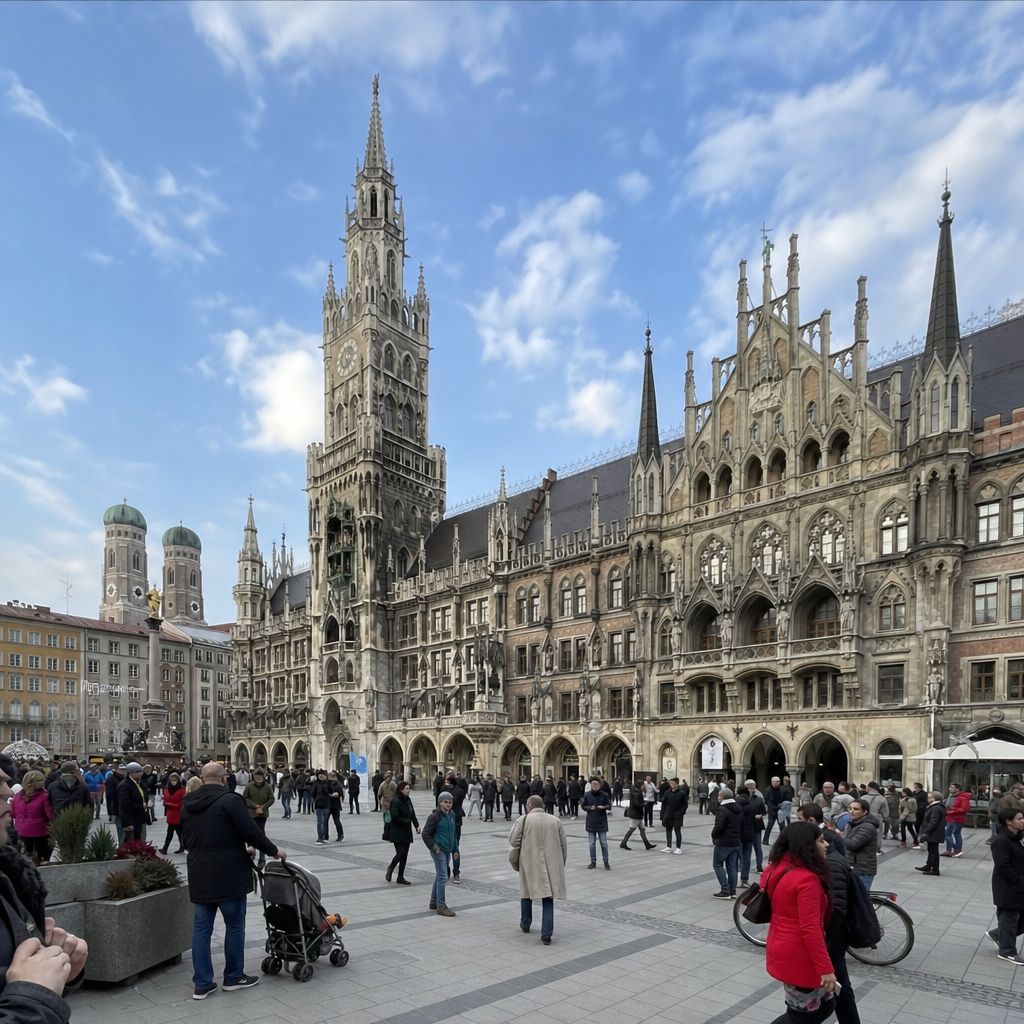
The Marienplatz is situated in the Altstadt (Old Town) district of Munich, at the intersection of key arterial roads and public transport lines. Originally established in 1158 as a salt and grain market, the square has undergone numerous transformations, reflecting the city's growth and modernization. Today, it functions as a multifunctional space, accommodating daily foot traffic of over 100,000 people, including tourists, residents, and business travelers. The square's layout is characterized by its open plaza design, flanked by historic buildings such as the New Town Hall (Neues Rathaus) and the Old Town Hall (Altes Rathaus), which house administrative and cultural institutions.
The Marienplatz's significance in transport and logistics stems from its role as a transfer point for multiple modes of transportation. Above ground, it serves as a major bus and tram terminal, while below ground, it connects to the Munich S-Bahn (suburban rail) and U-Bahn (underground metro) systems. The square's underground levels also include service tunnels and logistics corridors, facilitating the movement of goods to nearby commercial establishments without disrupting pedestrian flows. This vertical integration of transport layers is a hallmark of Munich's urban planning, designed to optimize space in a densely built environment.
From a mobility perspective, the Marienplatz exemplifies the challenges and opportunities of integrating historic urban spaces with modern transport demands. The square's pedestrianization in the 1970s marked a shift toward prioritizing non-motorized traffic, reducing congestion and improving air quality in the city center. However, the high volume of visitors and commuters requires continuous management of crowd flows, particularly during peak hours and major events such as the Oktoberfest. The square's design incorporates wide walkways, tactile paving for accessibility, and real-time digital signage to guide passengers through the complex network of transit options.
Historical Development
The Marienplatz's transformation into a transport hub is closely tied to Munich's broader urban development. In the 19th century, the square became a focal point for horse-drawn trams, which were later replaced by electric trams in the early 20th century. The introduction of the Munich U-Bahn in 1971, with the Marienplatz station serving as a central interchange, marked a turning point in the square's role within the city's transport network. The station's construction required extensive excavation beneath the historic square, a feat of engineering that preserved the above-ground architecture while creating a subterranean transit hub.
The square's logistics infrastructure has also evolved in response to changing commercial needs. In the medieval period, the Marienplatz was a marketplace for goods transported along trade routes from Italy and Austria. Today, its underground service tunnels accommodate deliveries to shops, restaurants, and hotels in the surrounding area, minimizing disruption to pedestrian traffic. The integration of these logistics corridors with the public transport system reflects Munich's commitment to sustainable urban mobility, reducing the reliance on freight vehicles in the city center.
Technical Infrastructure
The Marienplatz's transport infrastructure is supported by a sophisticated network of technical systems. The U-Bahn and S-Bahn stations are equipped with escalators, elevators, and platform screen doors to enhance passenger safety and accessibility. The stations' ventilation systems are designed to maintain air quality in the underground environment, while emergency exits and fire suppression systems ensure compliance with European Union safety standards (EN 1366-3 for fire resistance in transport infrastructure).
The square's above-ground tram network operates on a dedicated right-of-way, separated from pedestrian zones to improve efficiency and reduce conflicts between modes of transport. The tram tracks are embedded in a noise-reducing pavement system, which mitigates the impact of vibrations on nearby historic buildings. Additionally, the square's traffic management system employs adaptive signal control to prioritize public transport vehicles during peak hours, reducing delays and improving overall network performance.
Logistics operations beneath the Marienplatz are coordinated through a centralized control system, which monitors the movement of goods and ensures timely deliveries to commercial establishments. The underground service tunnels are equipped with climate control to protect sensitive goods, such as perishable food items, and are designed to accommodate electric delivery vehicles, aligning with Munich's goal of reducing carbon emissions in urban logistics.
Application Area
- Public Transport Hub: The Marienplatz serves as a primary interchange for Munich's U-Bahn (Lines U3 and U6) and S-Bahn (Lines S1–S8), connecting the city center to suburban and regional destinations. It also functions as a terminal for several tram lines (Lines 16, 17, 18, 19, and 21) and bus routes, making it one of the most heavily trafficked transport nodes in Germany.
- Pedestrian Mobility: The square's pedestrianized zones provide a safe and accessible environment for walking, with direct connections to major attractions such as the Viktualienmarkt and the Frauenkirche. The design prioritizes universal accessibility, featuring ramps, tactile guidance paths, and audible signals for visually impaired individuals.
- Urban Logistics: The underground logistics corridors facilitate the distribution of goods to retail stores, restaurants, and hotels in the Altstadt, reducing the need for surface-level freight traffic. This system supports Munich's efforts to create a more sustainable and efficient supply chain in the city center.
- Event Management: The Marienplatz is a key venue for public events, including festivals, protests, and celebrations. Its transport infrastructure is designed to handle large crowds, with temporary barriers, crowd control measures, and real-time passenger information systems to ensure safety and smooth operations.
Well Known Examples
- Munich U-Bahn and S-Bahn Stations: The Marienplatz station is one of the busiest in Munich's public transport network, with over 200,000 passengers passing through daily. Its design integrates historic elements, such as the preserved medieval city wall in the U-Bahn station, with modern amenities like digital departure boards and contactless payment systems.
- Oktoberfest Shuttle Services: During the annual Oktoberfest, the Marienplatz serves as a major transfer point for shuttle buses transporting visitors to and from the Theresienwiese festival grounds. Temporary bus lanes and crowd management systems are implemented to handle the surge in passenger volumes.
- Underground Logistics Network: The service tunnels beneath the Marienplatz are part of Munich's broader underground logistics system, which includes similar corridors in other parts of the city. This network is a model for integrating freight transport with public transit, reducing congestion and emissions in urban areas.
- New Town Hall (Neues Rathaus): The iconic building adjacent to the Marienplatz houses the city's administrative offices and is a major destination for tourists. Its proximity to the transport hub ensures high foot traffic, contributing to the square's role as a commercial and cultural center.
Risks and Challenges
- Crowd Management: The Marienplatz's high pedestrian traffic, particularly during peak hours and major events, poses challenges for crowd control. Overcrowding can lead to safety risks, such as trampling or delays in emergency response. The city employs dynamic crowd monitoring systems and temporary barriers to mitigate these risks.
- Infrastructure Aging: The underground transport infrastructure, including the U-Bahn and S-Bahn stations, requires regular maintenance to address wear and tear. The historic nature of the square complicates renovation efforts, as any construction work must preserve the above-ground architecture and minimize disruption to transport services.
- Air Quality and Noise Pollution: The concentration of public transport vehicles, including trams and buses, contributes to air pollution and noise levels in the square. Munich has implemented measures such as electric buses and noise-reducing pavement to address these issues, but ongoing monitoring is necessary to ensure compliance with environmental standards (e.g., EU Directive 2008/50/EC on ambient air quality).
- Security Threats: As a high-profile public space, the Marienplatz is a potential target for security threats, including terrorism and vandalism. The city has installed surveillance cameras, increased police presence, and implemented emergency response protocols to enhance security.
- Climate Resilience: The square's underground infrastructure is vulnerable to flooding, particularly during heavy rainfall or extreme weather events. Munich's climate adaptation strategies include improved drainage systems and flood barriers to protect transport and logistics operations.
Similar Terms
- Times Square, New York City, USA: Like the Marienplatz, Times Square is a major public transport hub and commercial center, integrating pedestrian zones with underground subway systems. However, Times Square is characterized by its high-rise buildings and digital advertising displays, reflecting a different urban context.
- Piccadilly Circus, London, UK: This iconic square serves as a transport interchange and tourist destination, similar to the Marienplatz. It features a mix of underground and surface-level transport options, as well as historic architecture, but is smaller in scale and lacks the same level of logistics integration.
- Shibuya Crossing, Tokyo, Japan: Known as the world's busiest pedestrian crossing, Shibuya Crossing shares the Marienplatz's role as a multimodal transport hub. However, its design prioritizes large-scale pedestrian flows over underground logistics, reflecting Tokyo's unique urban challenges.
Summary
The Marienplatz in Munich, Germany, is a multifunctional urban space that exemplifies the integration of historic architecture with modern transport and logistics infrastructure. As a central hub for public transit, pedestrian mobility, and underground logistics, it plays a critical role in Munich's urban mobility network. The square's technical infrastructure, including its U-Bahn and S-Bahn stations, tram network, and service tunnels, supports efficient passenger and freight movement while addressing challenges such as crowd management, aging infrastructure, and environmental sustainability. Its strategic location and adaptable design make it a model for other cities seeking to balance historic preservation with contemporary transport demands. The Marienplatz's ongoing evolution reflects Munich's commitment to creating a sustainable, accessible, and resilient urban environment.
--
Sources: European Union Directive 2008/50/EC; Munich Public Transport Authority (MVG); City of Munich Urban Planning Department; EN 1366-3 (European Standard for Fire Resistance in Transport Infrastructure).