
English: Los Angeles-Long Beach Port Complex USA / Español: Complejo Portuario de Los Ángeles-Long Beach (EE.UU.) / Português: Complexo Portuário de Los Angeles-Long Beach (EUA) / Français: Complexe portuaire de Los Angeles-Long Beach (États-Unis) / Italiano: Complesso portuale di Los Angeles-Long Beach (USA)
The Los Angeles-Long Beach Port Complex USA represents one of the most critical nodes in global trade and logistics. Situated along the Pacific Coast, this maritime hub facilitates the movement of goods between North America and Asia, serving as a cornerstone for supply chains worldwide. Its strategic location, infrastructure, and operational capacity make it indispensable for industries ranging from manufacturing to retail.
General Description
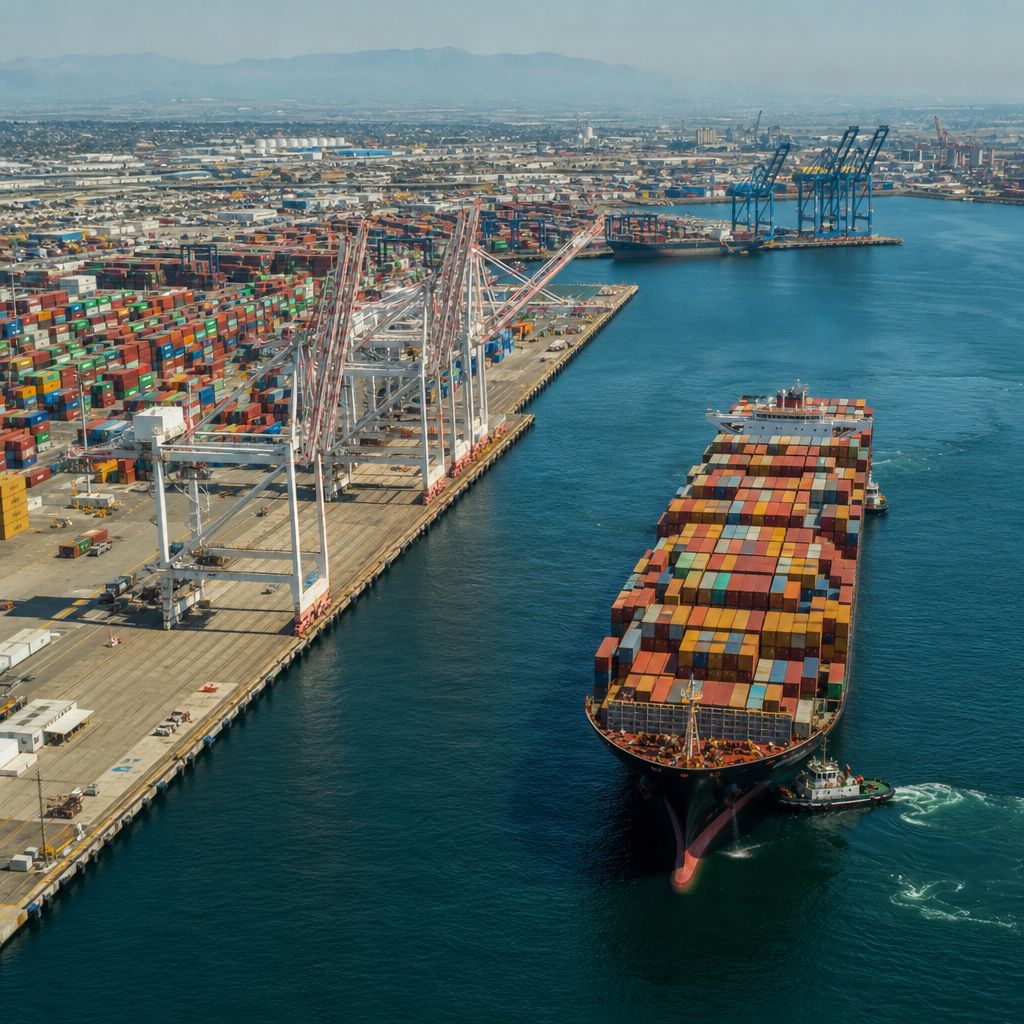
The Los Angeles-Long Beach Port Complex is the largest port complex in the Western Hemisphere and a primary gateway for trans-Pacific trade. Comprising the adjacent ports of Los Angeles and Long Beach in Southern California, it spans over 3,200 hectares (7,900 acres) of land and water, with more than 80 berths and 60 terminals. The complex handles a diverse range of cargo, including containerized goods, automobiles, bulk commodities, and liquid bulk products such as petroleum and chemicals. Its annual throughput exceeds 17 million twenty-foot equivalent units (TEUs), accounting for nearly 40% of all containerized imports entering the United States (Source: Port of Los Angeles, 2023).
The ports operate as independent entities under separate municipal governance but collaborate closely to optimize efficiency and reduce congestion. The Port of Los Angeles, established in 1907, is the busiest container port in the U.S., while the Port of Long Beach, founded in 1911, ranks as the second-busiest. Together, they form a seamless logistics ecosystem supported by rail networks, highways, and distribution centers. The complex's infrastructure includes deep-water channels, state-of-the-art cranes, and automated terminals, enabling it to accommodate the world's largest container ships, some exceeding 24,000 TEUs in capacity.
Environmental sustainability has become a defining feature of the port complex in recent years. Both ports have implemented ambitious initiatives to reduce emissions, such as the Clean Air Action Plan (CAAP), which aims to transition to zero-emission operations by 2030. These efforts include the adoption of shore power for docked vessels, electrification of cargo-handling equipment, and the use of renewable energy sources. Such measures not only address regulatory requirements but also respond to growing demands from consumers and businesses for greener supply chains.
Historical Development
The origins of the Los Angeles-Long Beach Port Complex trace back to the early 20th century, when the expansion of railroads and the Panama Canal's opening in 1914 positioned Southern California as a key trade hub. The Port of Los Angeles initially focused on bulk cargo, such as oil and lumber, while the Port of Long Beach specialized in petroleum exports. The post-World War II economic boom and the rise of containerization in the 1960s transformed the ports into major centers for global trade. The introduction of standardized shipping containers revolutionized logistics, drastically reducing transit times and costs.
In the 1980s and 1990s, the ports underwent significant modernization to accommodate larger vessels and increasing cargo volumes. The construction of the Alameda Corridor, a 32-kilometer (20-mile) freight rail expressway completed in 2002, further enhanced the complex's efficiency by connecting the ports directly to national rail networks. This project reduced truck traffic on local highways and cut transit times for goods moving inland. The 21st century has seen the ports embrace automation and digitalization, with investments in terminal operating systems, artificial intelligence, and blockchain technology to streamline operations and improve transparency.
Technical Infrastructure
The Los Angeles-Long Beach Port Complex boasts a robust technical infrastructure designed to handle high cargo volumes with precision. Its deep-water channels, maintained at depths of up to 16 meters (52 feet), allow for the berthing of ultra-large container vessels (ULCVs). The ports utilize advanced crane systems, including ship-to-shore (STS) cranes capable of lifting containers weighing up to 65 metric tons (72 short tons). Automated guided vehicles (AGVs) and rail-mounted gantry cranes further enhance terminal efficiency by reducing manual labor and minimizing human error.
Intermodal connectivity is a hallmark of the complex's infrastructure. The ports are linked to major freight railroads, such as the Union Pacific and BNSF Railway, which transport goods to distribution centers across the U.S. The nearby Interstate 710 and Interstate 110 highways provide direct access to the national road network, facilitating the movement of cargo by truck. Additionally, the ports feature on-dock rail facilities, allowing containers to be transferred directly from ships to trains, thereby reducing congestion and emissions associated with trucking.
Environmental technologies play an increasingly vital role in the complex's operations. Shore power systems enable docked vessels to shut down their auxiliary engines and connect to the electrical grid, reducing air pollution. The ports have also invested in liquefied natural gas (LNG) and hydrogen fuel cell technologies for cargo-handling equipment. Furthermore, the implementation of the Port Community System (PCS), a digital platform for real-time data sharing among stakeholders, has improved coordination and reduced delays in cargo processing.
Application Area
- Global Trade and Supply Chains: The Los Angeles-Long Beach Port Complex serves as a critical link in global supply chains, facilitating the import and export of goods between North America, Asia, and beyond. It handles a wide range of products, including electronics, apparel, furniture, and agricultural commodities, making it indispensable for retailers, manufacturers, and consumers.
- Automotive Logistics: The ports are a major hub for automotive imports and exports, with dedicated terminals for vehicles and auto parts. Manufacturers rely on the complex's efficient handling and distribution networks to supply dealerships and production facilities across the U.S. and Mexico.
- Energy and Bulk Commodities: The complex plays a key role in the energy sector, handling liquid bulk products such as crude oil, refined petroleum, and liquefied natural gas (LNG). It also manages bulk cargo like coal, cement, and grains, supporting industries ranging from construction to food production.
- E-Commerce and Retail: With the rise of e-commerce, the ports have become vital for the rapid movement of consumer goods. Retailers such as Amazon and Walmart depend on the complex's infrastructure to ensure timely delivery of products to warehouses and fulfillment centers.
Well Known Examples
- TraPac Terminal (Port of Los Angeles): One of the most advanced automated container terminals in the world, TraPac utilizes automated stacking cranes and AGVs to handle cargo with minimal human intervention. Its operations serve as a model for efficiency and sustainability in the maritime industry.
- Middle Harbor Terminal (Port of Long Beach): A fully automated terminal featuring state-of-the-art technology, including remote-controlled cranes and a computerized terminal operating system. Middle Harbor has significantly reduced emissions and improved productivity, setting new standards for green port operations.
- Alameda Corridor: This freight rail expressway connects the ports to the national rail network, reducing transit times and congestion. The corridor has become a critical component of the complex's intermodal infrastructure, enabling seamless cargo movement across the U.S.
- Clean Truck Program: Implemented in 2008, this initiative requires trucks serving the ports to meet strict emissions standards. The program has led to a significant reduction in air pollution and serves as a benchmark for sustainable logistics practices worldwide.
Risks and Challenges
- Congestion and Delays: The sheer volume of cargo handled by the Los Angeles-Long Beach Port Complex often leads to congestion, resulting in delays for ships, trucks, and trains. Factors such as labor disputes, equipment shortages, and peak season surges exacerbate these challenges, impacting supply chain reliability.
- Environmental Regulations: While sustainability initiatives are a priority, compliance with stringent environmental regulations poses operational and financial challenges. The transition to zero-emission technologies requires significant investment and may disrupt existing workflows during implementation.
- Labor Disputes: The ports have experienced periodic labor disputes between terminal operators and dockworker unions, leading to work stoppages and disruptions. Such conflicts can have far-reaching consequences for global trade, as seen during the 2014-2015 contract negotiations.
- Infrastructure Limitations: Despite ongoing modernization efforts, the ports face infrastructure constraints, such as limited land availability and aging facilities. Expanding capacity while maintaining operational efficiency remains a persistent challenge.
- Cybersecurity Threats: The increasing digitalization of port operations exposes the complex to cybersecurity risks, including data breaches and ransomware attacks. Protecting critical infrastructure from cyber threats is essential to ensuring the continuity of trade flows.
- Competition from Other Ports: The rise of competing ports, such as those in Mexico and Canada, poses a threat to the Los Angeles-Long Beach Port Complex's dominance. These ports offer alternative routes for cargo, potentially diverting trade away from Southern California.
Similar Terms
- Port of Shanghai (China): The world's busiest container port, handling over 47 million TEUs annually. Like the Los Angeles-Long Beach Port Complex, it serves as a critical hub for global trade but operates on a larger scale and with a greater focus on exports.
- Port of Rotterdam (Netherlands): Europe's largest port and a key gateway for trade between Europe and Asia. It is renowned for its advanced automation and sustainability initiatives, similar to those implemented in Los Angeles and Long Beach.
- Port of Singapore: A major transshipment hub in Southeast Asia, known for its efficiency and strategic location. The port handles a significant share of global maritime trade and serves as a model for other ports in terms of operational excellence.
- Algeciras Port (Spain): One of the busiest ports in the Mediterranean, serving as a critical link between Europe, Africa, and the Americas. Its strategic location and modern infrastructure make it a key competitor to the Los Angeles-Long Beach Port Complex in certain trade lanes.
Summary
The Los Angeles-Long Beach Port Complex stands as a vital engine of global trade, connecting North America to markets across the Pacific and beyond. Its unparalleled infrastructure, strategic location, and commitment to sustainability have cemented its role as a cornerstone of modern logistics. However, the complex faces ongoing challenges, including congestion, environmental regulations, and competition from other ports, which require continuous innovation and collaboration among stakeholders. As the demands of global trade evolve, the Los Angeles-Long Beach Port Complex will remain a critical node in the supply chain, driving economic growth and shaping the future of maritime logistics.
--