
Deutsch: Verkehr in Los Angeles / Español: Tráfico en Los Ángeles / Português: Trânsito em Los Angeles / Français: Trafic à Los Angeles / Italiano: Traffico a Los Angeles
Los Angeles Traffic refers to the complex and often congested transportation network in the Greater Los Angeles metropolitan area, a region notorious for its reliance on private vehicles, sprawling urban layout, and frequent gridlock. As one of the most car-dependent cities in the world, Los Angeles faces unique challenges in mobility, logistics, and urban planning, shaping both its economic activities and daily life for residents and businesses alike.
General Description
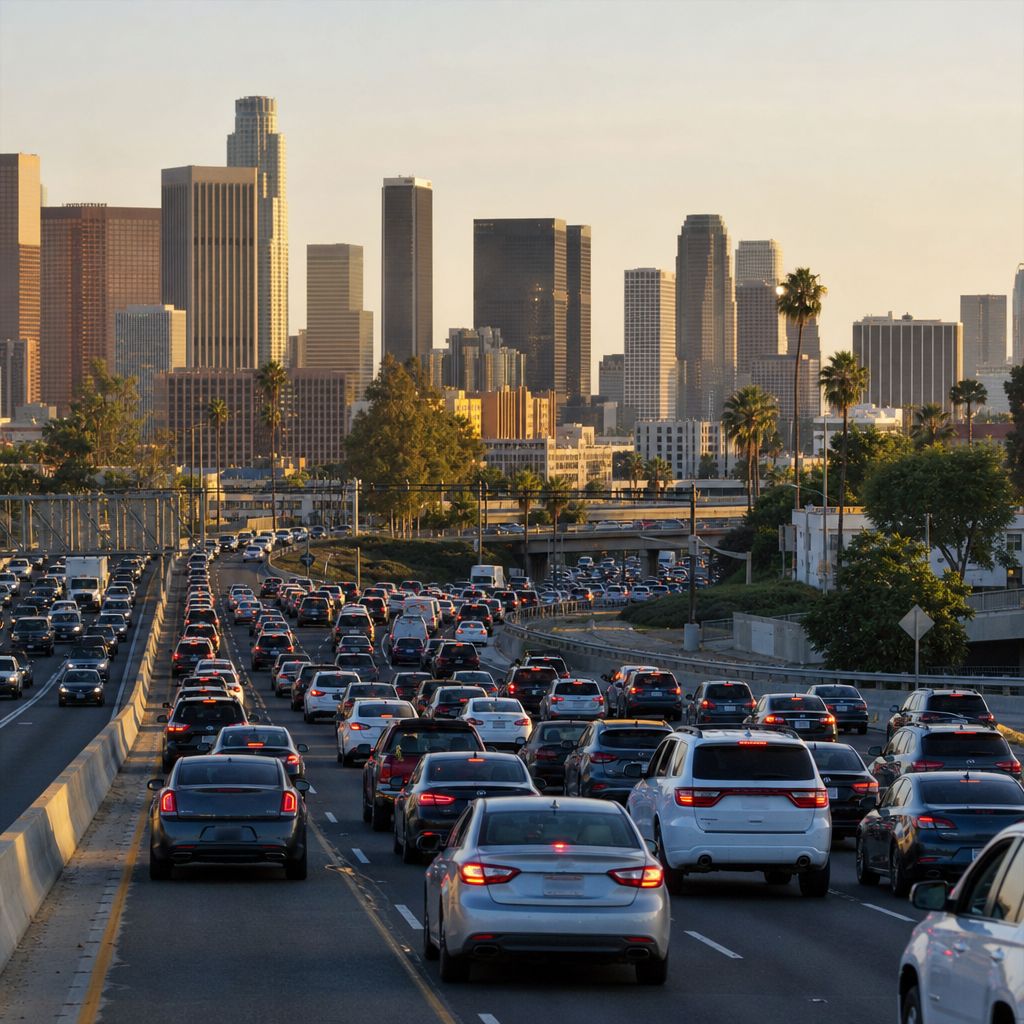
Los Angeles Traffic is a multifaceted phenomenon influenced by historical, geographical, and socio-economic factors. The city's development in the 20th century was heavily shaped by automobile-centric urban planning, leading to a low-density, decentralized urban sprawl that spans over 12,500 square kilometers. This sprawl, combined with a population of approximately 13 million people in the metropolitan area, results in high vehicle miles traveled (VMT) per capita, making traffic congestion a persistent issue. Unlike older cities with well-established public transit systems, Los Angeles has historically prioritized road infrastructure, including an extensive network of freeways such as the Interstate 405 (I-405) and U.S. Route 101.
The traffic patterns in Los Angeles are characterized by peak-hour congestion, particularly during morning and evening commutes, but also by non-recurrent congestion caused by accidents, roadwork, or special events. The region's topography, with its mountain ranges and coastal geography, further complicates traffic flow, as key routes like the Sepulveda Pass or the Cahuenga Pass become bottlenecks. Additionally, the city's role as a global hub for trade, entertainment, and logistics contributes to heavy freight traffic, particularly around the Port of Los Angeles and Los Angeles International Airport (LAX), which are among the busiest in the world.
Efforts to mitigate traffic congestion have included expansions of public transit, such as the Los Angeles Metro Rail system, as well as initiatives to promote alternative transportation modes like cycling and ridesharing. However, the cultural and structural dependence on cars remains deeply ingrained, posing ongoing challenges for policymakers and urban planners. The economic costs of traffic congestion in Los Angeles are substantial, with estimates suggesting billions of U.S. dollars lost annually due to wasted fuel, delayed deliveries, and reduced productivity (source: Texas A&M Transportation Institute, Urban Mobility Report).
Historical Development
The evolution of Los Angeles Traffic is closely tied to the city's growth and its relationship with the automobile. In the early 20th century, Los Angeles was a relatively compact city with a streetcar system operated by the Pacific Electric Railway, which connected downtown with surrounding neighborhoods and suburbs. However, the rise of the automobile in the 1920s and 1930s led to a shift in urban planning priorities. The construction of freeways, beginning with the Arroyo Seco Parkway in 1940, marked the start of a car-centric transportation policy that would define the region's development for decades.
The post-World War II era saw a rapid expansion of the freeway system, fueled by federal funding and the growing popularity of suburban living. Freeways like the I-5, I-10, and I-405 became the backbone of the region's transportation network, enabling the sprawl of residential and commercial developments across the Los Angeles Basin. However, this expansion also led to the decline of public transit, as streetcar lines were dismantled in favor of bus services, which were often slower and less reliable. By the 1960s, Los Angeles had earned a reputation as a city built for cars, with traffic congestion becoming an increasingly visible problem.
In recent decades, efforts to address traffic congestion have focused on revitalizing public transit and promoting sustainable mobility. The opening of the Los Angeles Metro Rail system in 1990 marked a turning point, with subsequent expansions adding light rail and subway lines to connect key areas of the city. Despite these efforts, the share of commuters using public transit remains relatively low compared to other major global cities, reflecting the enduring challenges of shifting away from car dependency.
Technical and Logistical Challenges
Managing Los Angeles Traffic involves addressing a range of technical and logistical challenges, particularly in the realms of infrastructure, data analytics, and policy implementation. One of the primary technical challenges is the optimization of traffic signal timing to reduce congestion and improve flow. The city's Traffic Management Center (TMC) uses advanced systems such as the Automated Traffic Surveillance and Control (ATSAC) to monitor and adjust signal timings in real time, but the sheer scale of the network—with over 4,500 signalized intersections—makes this a complex task.
Another critical challenge is the integration of freight and passenger traffic. The Port of Los Angeles, the busiest container port in the Western Hemisphere, handles over 9 million twenty-foot equivalent units (TEUs) annually, generating significant truck traffic on routes like the I-710 and I-110 freeways. Coordinating the movement of goods while minimizing disruptions to passenger traffic requires careful planning, including the use of dedicated truck lanes and off-peak delivery schedules. The Alameda Corridor, a 32-kilometer freight rail expressway, was developed to reduce truck traffic by consolidating rail shipments, but congestion on surface streets remains a persistent issue.
Data-driven approaches are increasingly being used to address traffic challenges. The city leverages technologies such as intelligent transportation systems (ITS), which include real-time traffic monitoring, dynamic message signs, and adaptive signal control. Additionally, the rise of mobility-as-a-service (MaaS) platforms, such as ride-hailing apps and bike-sharing programs, has introduced new dynamics to the traffic ecosystem. While these services offer flexibility, they also contribute to congestion, particularly in dense urban areas like downtown Los Angeles and Hollywood.
Application Area
- Urban Planning and Infrastructure: Los Angeles Traffic is a central consideration in urban planning, influencing decisions about land use, zoning, and the development of transportation infrastructure. Planners must balance the need for new roads and transit lines with the goal of reducing car dependency and promoting sustainable mobility.
- Logistics and Freight Management: The movement of goods through Los Angeles is critical to the regional and national economy. Traffic congestion directly impacts supply chains, leading to delays and increased costs for businesses. Solutions such as off-peak deliveries and the expansion of rail infrastructure are key to improving efficiency.
- Public Transit and Mobility Services: The Los Angeles Metro system and other public transit providers play a vital role in reducing traffic congestion by offering alternatives to private vehicles. Initiatives like the Metro Bike Share program and partnerships with ride-hailing companies aim to create a more integrated and accessible transportation network.
- Environmental and Public Health: Traffic congestion in Los Angeles contributes to air pollution and greenhouse gas emissions, posing significant public health risks. Efforts to reduce traffic, such as promoting electric vehicles and expanding public transit, are essential for improving air quality and mitigating climate change.
- Economic Impact Analysis: Traffic congestion has measurable economic costs, including lost productivity, increased fuel consumption, and higher transportation costs for businesses. Analyzing these impacts helps policymakers prioritize investments in infrastructure and mobility solutions.
Well Known Examples
- Interstate 405 (I-405): Often referred to as the "405," this freeway is one of the most congested in the United States, particularly through the Sepulveda Pass. It serves as a critical north-south route for both commuters and freight traffic, and its frequent gridlock has made it a symbol of Los Angeles Traffic challenges.
- Los Angeles Metro Rail: The city's expanding light rail and subway system, including the Red, Purple, and Expo Lines, provides an alternative to car travel. The system has seen significant ridership growth, particularly with the opening of new lines like the Crenshaw/LAX Line, which connects to Los Angeles International Airport.
- Port of Los Angeles and Alameda Corridor: The port is a major driver of freight traffic in the region, handling billions of U.S. dollars in goods annually. The Alameda Corridor, a below-grade rail expressway, was built to reduce truck traffic by consolidating rail shipments between the port and inland rail yards.
- Carmageddon (2011 and 2012): These events involved the temporary closure of sections of the I-405 for construction, leading to widespread concerns about traffic chaos. The relatively smooth outcome demonstrated the effectiveness of public awareness campaigns and alternative routing strategies.
- Metro Bike Share: Launched in 2016, this bike-sharing program provides an additional mobility option for short trips, particularly in downtown Los Angeles and surrounding neighborhoods. It aims to reduce reliance on cars for short-distance travel and complement the public transit system.
Risks and Challenges
- Air Pollution and Public Health: Traffic congestion in Los Angeles contributes to high levels of air pollution, including particulate matter (PM2.5) and nitrogen oxides (NOx), which are linked to respiratory diseases and other health issues. The region frequently exceeds air quality standards set by the U.S. Environmental Protection Agency (EPA).
- Economic Costs: The Texas A&M Transportation Institute estimates that traffic congestion costs the Los Angeles region billions of U.S. dollars annually in lost productivity, wasted fuel, and increased transportation costs for businesses. These costs are expected to rise as the population grows.
- Infrastructure Aging and Maintenance: Much of Los Angeles' road and freeway infrastructure was built in the mid-20th century and requires significant investment to maintain and upgrade. Delays in maintenance can exacerbate congestion and increase the risk of accidents.
- Equity and Accessibility: Traffic congestion disproportionately affects low-income communities, who often rely on public transit and face longer commute times. Improving accessibility and affordability of transportation options is a key challenge for policymakers.
- Climate Change and Resilience: Rising temperatures and extreme weather events, such as wildfires and heatwaves, can disrupt traffic patterns and infrastructure. Adapting the transportation system to climate change is an emerging priority for the region.
- Technological Disruptions: The rise of autonomous vehicles, ride-hailing services, and other mobility innovations presents both opportunities and challenges. While these technologies could improve traffic flow, they may also increase vehicle miles traveled and congestion if not properly regulated.
Similar Terms
- Urban Sprawl: Refers to the low-density, decentralized development pattern seen in Los Angeles, which contributes to traffic congestion by increasing the distance between residential, commercial, and employment centers. Urban sprawl is often associated with car dependency and inefficient land use.
- Intelligent Transportation Systems (ITS): A broad term encompassing technologies such as real-time traffic monitoring, adaptive signal control, and dynamic message signs, which are used to manage and optimize traffic flow in cities like Los Angeles.
- Vehicle Miles Traveled (VMT): A metric used to measure the total distance traveled by vehicles in a given area. High VMT per capita is a key indicator of traffic congestion and car dependency, as seen in Los Angeles.
- Mobility-as-a-Service (MaaS): An integrated approach to transportation that combines public transit, ride-hailing, bike-sharing, and other mobility services into a single, accessible platform. MaaS aims to reduce reliance on private vehicles and improve traffic flow.
- Freight Congestion: Refers to the delays and inefficiencies caused by the movement of goods, particularly in urban areas with heavy truck traffic. In Los Angeles, freight congestion is a major issue due to the high volume of goods passing through the Port of Los Angeles.
Summary
Los Angeles Traffic is a defining feature of the region's transportation landscape, shaped by its car-centric urban planning, sprawling geography, and role as a global hub for trade and logistics. While the city's reliance on private vehicles has led to persistent congestion and environmental challenges, efforts to expand public transit, promote sustainable mobility, and leverage technology offer potential solutions. However, addressing the economic, social, and environmental impacts of traffic congestion will require coordinated action from policymakers, businesses, and residents. As Los Angeles continues to grow, the management of its traffic system will remain a critical factor in determining the region's livability, economic competitiveness, and sustainability.
--