
Deutsch: Autobahn Deutschland / Español: Autobahn Alemania / Português: Autobahn Alemanha / Français: Autoroute allemande / Italiano: Autobahn Germania
The Autobahn Germany represents one of the most iconic and extensively developed highway systems in the world, serving as a cornerstone of the country's transport infrastructure. Designed to facilitate high-speed travel and heavy freight movement, it plays a pivotal role in both domestic mobility and international logistics. As a symbol of engineering efficiency and economic connectivity, the Autobahn network reflects Germany's commitment to modernizing transport while balancing environmental and safety considerations.
General Description
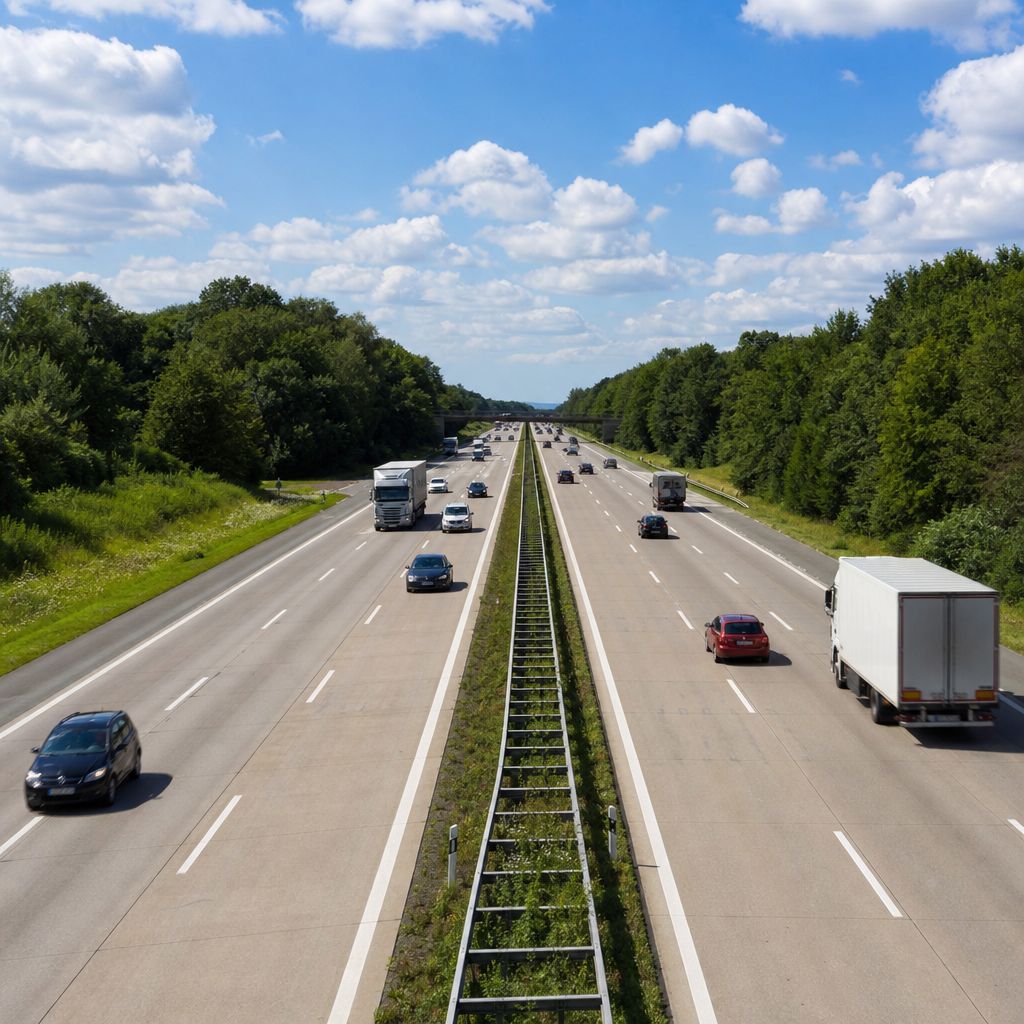
The Autobahn Germany is a federally controlled network of high-speed roadways that spans over 13,000 kilometers, making it one of the densest highway systems globally. Unlike many other countries' motorways, the Autobahn is renowned for its lack of a general speed limit on certain sections, though dynamic speed regulations are enforced in high-traffic or hazardous areas. The system is primarily designed for motorized vehicles, with restrictions on slow-moving traffic such as bicycles, pedestrians, and agricultural machinery to ensure fluidity and safety.
The construction of the Autobahn began in the 1930s under the National Socialist regime, initially as a strategic infrastructure project to improve military mobility and economic growth. However, its expansion continued significantly in the post-war era, particularly during Germany's economic miracle (Wirtschaftswunder) in the 1950s and 1960s. Today, the network is maintained by the federal government and financed through a combination of fuel taxes, vehicle tolls for commercial trucks, and general taxation. The Autobahn is not only a critical component of Germany's domestic transport but also a key link in the Trans-European Transport Network (TEN-T), facilitating cross-border trade and travel within the European Union.
The design of the Autobahn adheres to rigorous engineering standards, including multiple lanes in each direction, emergency lanes (Standstreifen), and advanced traffic management systems. These features are intended to minimize congestion and reduce the risk of accidents, though the absence of a universal speed limit remains a subject of ongoing debate. The network is also equipped with rest areas (Raststätten), service stations, and dynamic signage to provide real-time information to drivers. Environmental considerations, such as noise barriers and wildlife crossings, are increasingly integrated into modern expansions to mitigate the ecological impact of high-speed road traffic.
Technical Specifications
The Autobahn Germany is built to accommodate high volumes of traffic while maintaining safety and efficiency. Most sections feature at least two lanes per direction, with three or more lanes common in urban and high-traffic areas. The road surface is typically constructed from reinforced concrete or asphalt, designed to withstand heavy loads and extreme weather conditions. The maximum gradient for Autobahn sections is limited to 4 percent to ensure vehicle stability, particularly for trucks, while curves are engineered with a minimum radius of 1,000 meters to allow safe high-speed travel.
Traffic management on the Autobahn relies on advanced technologies, including variable message signs (Wechselverkehrszeichen), speed cameras, and automated incident detection systems. These tools help regulate traffic flow, particularly during peak hours or in the event of accidents. The absence of a general speed limit on approximately 70 percent of the network does not imply a lack of regulation; instead, recommended speed limits of 130 kilometers per hour (km/h) are posted in many areas, and stricter limits are enforced in construction zones, urban areas, and sections prone to congestion or adverse weather conditions. For commercial vehicles, a universal speed limit of 80 km/h applies to ensure safety and reduce wear on the road infrastructure.
Environmental sustainability is an increasingly important aspect of Autobahn design. Noise pollution is addressed through the installation of sound barriers, particularly in residential areas, while wildlife crossings (Grünbrücken) are constructed to allow animals to safely traverse the highway. Additionally, the German government has invested in expanding the network of electric vehicle charging stations along the Autobahn to support the transition to low-emission mobility. These measures reflect a broader commitment to reducing the environmental footprint of road transport while maintaining the system's functionality.
Historical Development
The origins of the Autobahn Germany can be traced back to the early 20th century, with the first plans for a national highway network emerging in the 1920s. However, large-scale construction did not begin until 1933, when the National Socialist government launched the Reichsautobahn project as part of its economic and military strategy. The first completed section, connecting Frankfurt and Darmstadt, opened in 1935 and set the standard for future Autobahn construction. By the outbreak of World War II, approximately 2,000 kilometers of Autobahn had been completed, though the network's expansion was halted due to the war's demands.
After the war, the Autobahn system fell into disrepair, with many sections damaged or neglected. Reconstruction efforts began in the late 1940s, driven by the need to support Germany's post-war economic recovery. The 1950s and 1960s saw a rapid expansion of the network, with new sections connecting major cities such as Hamburg, Munich, and Cologne. This period also marked the introduction of modern traffic management systems and the standardization of Autobahn design, including the adoption of emergency lanes and rest areas. By the 1970s, the Autobahn had become a symbol of Germany's economic prosperity and technological advancement.
In recent decades, the focus of Autobahn development has shifted toward modernization and sustainability. The reunification of Germany in 1990 led to the integration of the former East German highway network, which required significant upgrades to meet Western standards. Today, ongoing projects aim to expand capacity, improve safety, and reduce environmental impact. For example, the Bundesverkehrswegeplan (Federal Transport Infrastructure Plan) outlines priorities for Autobahn expansion and maintenance, with an emphasis on digitalization, such as the implementation of intelligent traffic systems and autonomous vehicle testing zones.
Application Area
- Passenger Transport: The Autobahn is the backbone of Germany's passenger transport system, enabling efficient travel between cities and regions. It is particularly vital for commuters, long-distance travelers, and tourists, offering direct connections to airports, train stations, and major urban centers. The network's high-speed capabilities reduce travel times and enhance mobility for millions of people annually.
- Freight and Logistics: As a critical component of the European logistics network, the Autobahn facilitates the movement of goods across Germany and beyond. Trucks account for a significant portion of Autobahn traffic, transporting raw materials, manufactured goods, and consumer products. The network's integration with ports, rail terminals, and industrial hubs ensures seamless supply chain operations, supporting Germany's role as a global export leader.
- International Connectivity: The Autobahn serves as a key link in the Trans-European Transport Network (TEN-T), connecting Germany to neighboring countries such as France, Austria, Switzerland, and the Netherlands. This cross-border connectivity is essential for trade, tourism, and cultural exchange within the European Union. For example, the Autobahn A5 connects Frankfurt to Basel, Switzerland, while the A3 links the Ruhr region to the Netherlands and Belgium.
- Emergency and Public Services: The Autobahn plays a crucial role in emergency response and public services. Police, fire departments, and medical services rely on the network for rapid deployment, particularly in rural areas where alternative routes may be limited. The emergency lanes and rest areas also provide safe havens for stranded motorists and facilitate the coordination of rescue operations.
Well Known Examples
- Autobahn A7: Stretching over 963 kilometers, the A7 is the longest Autobahn in Germany, connecting Flensburg on the Danish border to Füssen near the Austrian border. It serves as a vital north-south corridor, linking major cities such as Hamburg, Hanover, and Würzburg. The A7 is also a critical route for freight transport, particularly for goods moving between Scandinavia and Central Europe.
- Autobahn A8: Running from the Luxembourg border near Perl to the Austrian border near Salzburg, the A8 is a key east-west route that connects the Saarland, Baden-Württemberg, and Bavaria. It is one of the busiest Autobahn sections, particularly around Munich, where it intersects with the A9 and A99. The A8 is also renowned for its scenic stretches, such as the section passing through the Black Forest.
- Autobahn A1: Known as the Hansalinie, the A1 connects the port city of Hamburg to the Ruhr region and extends southward to Saarbrücken. It is a major artery for both passenger and freight traffic, particularly for goods transported between the North Sea ports and Germany's industrial heartland. The A1 is also notable for its role in connecting Germany to Belgium and France via the A44 and A6.
- Autobahn A3: This Autobahn runs from the Dutch border near Emmerich to the Austrian border near Passau, passing through major cities such as Cologne, Frankfurt, and Nuremberg. The A3 is one of the most heavily trafficked routes in Germany, serving as a critical link for both domestic and international transport. It is also a key route for trucks traveling between the Netherlands and Eastern Europe.
Risks and Challenges
- Traffic Congestion: Despite its extensive network, the Autobahn is prone to congestion, particularly in urban areas and during peak travel times. Bottlenecks at major intersections, such as the Frankfurter Kreuz (A3/A5) or the Kamener Kreuz (A1/A2), can lead to significant delays, increasing travel times and fuel consumption. The German government has implemented measures such as dynamic speed limits and lane management systems to alleviate congestion, but demand continues to outpace capacity in many areas.
- Safety Concerns: The absence of a general speed limit on certain Autobahn sections poses safety challenges, particularly for inexperienced drivers or in adverse weather conditions. While Germany's road fatality rate is relatively low compared to other countries, high-speed accidents can result in severe injuries or fatalities. To address this, authorities enforce stricter speed limits in high-risk areas and invest in advanced traffic monitoring systems to detect and respond to incidents quickly.
- Environmental Impact: The Autobahn's extensive network has significant environmental consequences, including habitat fragmentation, noise pollution, and greenhouse gas emissions. The construction and maintenance of highways disrupt ecosystems, while vehicle emissions contribute to air pollution and climate change. Efforts to mitigate these impacts include the installation of noise barriers, the creation of wildlife crossings, and the promotion of electric vehicles. However, balancing environmental sustainability with the demands of a growing transport sector remains a complex challenge.
- Maintenance and Upkeep: The Autobahn requires continuous maintenance to ensure safety and functionality, including resurfacing, bridge repairs, and the replacement of aging infrastructure. The cost of upkeep is substantial, with the federal government allocating billions of euros annually to maintain and expand the network. Delays in maintenance can lead to road closures, detours, and increased wear on vehicles, highlighting the need for long-term investment in infrastructure.
- Political and Public Debate: The Autobahn is a subject of ongoing political and public debate, particularly regarding the absence of a general speed limit. Proponents argue that speed limits are unnecessary due to Germany's high safety standards and well-trained drivers, while opponents cite environmental concerns and the need to reduce accident risks. The debate reflects broader tensions between individual freedom, economic efficiency, and sustainability in transport policy.
Similar Terms
- Autoroute (France): The French autoroute system is comparable to the Autobahn in terms of design and function, featuring high-speed roadways with multiple lanes and limited access. However, France enforces a general speed limit of 130 km/h on its autoroutes, with lower limits in adverse weather conditions. The system is operated by private concessionaires, which charge tolls for usage, unlike the Autobahn, which is primarily toll-free for passenger vehicles.
- Autostrada (Italy): Italy's autostrada network is another example of a high-speed highway system, connecting major cities and regions across the country. Like the Autobahn, the autostrada features multiple lanes and advanced traffic management systems, but it operates under a toll-based model. Speed limits on Italian autostrade are set at 130 km/h, with stricter limits in urban areas and tunnels.
- Interstate Highway System (United States): The U.S. Interstate Highway System is a nationwide network of high-speed roadways designed for long-distance travel and freight transport. While it shares similarities with the Autobahn, such as multiple lanes and limited access, the Interstate system operates under a universal speed limit, typically ranging from 105 to 120 km/h depending on the state. The system is funded through federal and state taxes, with no tolls on most sections.
- Motorway (United Kingdom): The UK's motorway network consists of high-speed roadways designed for efficient travel between cities and regions. Motorways in the UK enforce a speed limit of 112 km/h for passenger vehicles, with lower limits for trucks and buses. The system is maintained by the government and funded through taxation, with no tolls on most sections, though some bridges and tunnels require payment.
Summary
The Autobahn Germany is a cornerstone of the country's transport infrastructure, renowned for its extensive network, high-speed capabilities, and integration with European logistics systems. Spanning over 13,000 kilometers, it facilitates passenger travel, freight transport, and international connectivity while adhering to rigorous engineering and safety standards. Despite its efficiency, the Autobahn faces challenges such as congestion, safety risks, and environmental impact, which require ongoing investment and innovation to address. As Germany continues to modernize its transport sector, the Autobahn remains a symbol of the country's commitment to mobility, economic growth, and sustainability.
--