
Deutsch: Alexanderplatz, Berlin, Deutschland / Español: Alexanderplatz, Berlín, Alemania / Português: Alexanderplatz, Berlim, Alemanha / Français: Alexanderplatz, Berlin, Allemagne / Italiano: Alexanderplatz, Berlino, Germania
The Alexanderplatz, Berlin, Germany stands as one of the most iconic urban squares in Europe, serving as a central hub for transport, logistics, and mobility in the German capital. Originally designed as a marketplace in the 19th century, it has evolved into a multifunctional node that integrates public transportation, commercial activity, and cultural significance. Its strategic location and historical development reflect broader trends in urban planning and infrastructure modernization.
General Description
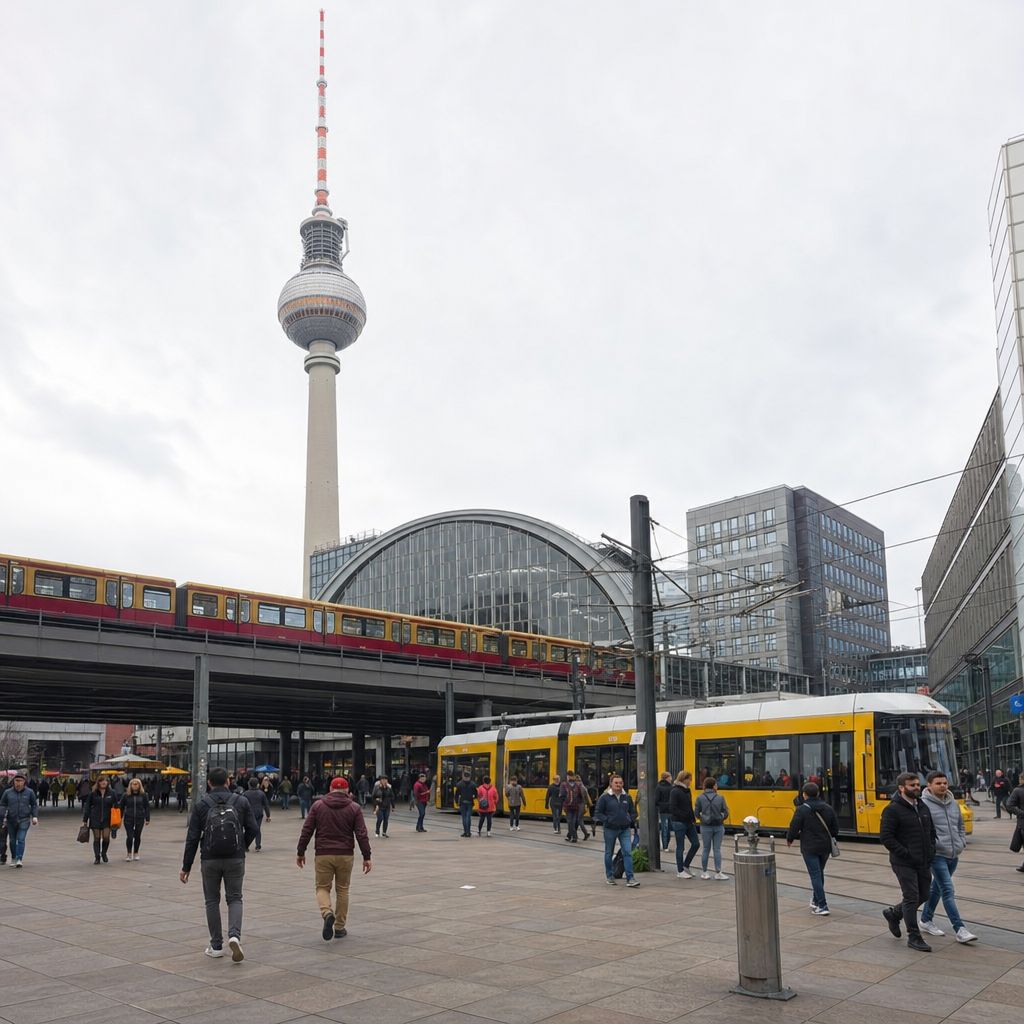
The Alexanderplatz, often referred to simply as "Alex" by locals, is situated in the Mitte district of Berlin, near the historic city center. Its origins trace back to the early 1800s when it was established as a cattle market outside the city walls. Named after Tsar Alexander I of Russia during his visit to Berlin in 1805, the square gradually transformed into a bustling commercial and transportation hub as the city expanded. By the late 19th century, it had become a key intersection for horse-drawn trams and later electric streetcars, solidifying its role in Berlin's urban mobility network.
The square's layout and architecture have undergone multiple redesigns, particularly after the extensive damage sustained during World War II. The post-war period saw a radical reconstruction under East German rule, characterized by socialist modernist architecture. Notable structures such as the Fernsehturm (TV Tower), the World Time Clock (Urania-Weltzeituhr), and the Haus des Lehrers (House of the Teacher) were erected during this era, symbolizing technological progress and ideological aspirations. The Fernsehturm, completed in 1969, remains one of the tallest structures in Europe, serving both as a broadcasting tower and a tourist attraction with an observation deck at 203 meters above ground level.
Today, the Alexanderplatz functions as a critical node in Berlin's public transportation system. It is served by multiple modes of transport, including the U-Bahn (underground subway), S-Bahn (urban rail), trams, buses, and regional trains. The U-Bahn lines U2, U5, and U8 intersect here, while the S-Bahn lines S3, S5, S7, and S9 provide connections to the broader metropolitan region. This multimodal integration facilitates the movement of approximately 360,000 passengers daily, making it one of the busiest transport hubs in Germany (source: Berliner Verkehrsbetriebe, BVG). The square's pedestrian zones and cycling paths further enhance its accessibility, aligning with Berlin's commitment to sustainable urban mobility.
Historical Development
The evolution of the Alexanderplatz mirrors Berlin's turbulent history and its adaptation to changing political and economic conditions. In the 19th century, the square was primarily a marketplace and a transit point for goods and people entering the city. The introduction of the first horse-drawn tram in 1877 marked the beginning of its transformation into a transport hub. By the early 20th century, electric trams and the construction of the U-Bahn in 1913 further cemented its role in urban mobility. The square's commercial significance grew with the establishment of department stores such as the Tietz and Wertheim, which attracted shoppers from across the city.
The devastation of World War II left the Alexanderplatz in ruins, prompting a comprehensive reconstruction plan under the German Democratic Republic (GDR). The socialist government envisioned the square as a showcase of modernity and progress, leading to the demolition of many historic buildings and the construction of large-scale, functionalist structures. The 1960s and 1970s saw the completion of the Fernsehturm, the Hotel Stadt Berlin (now Park Inn by Radisson), and the Kaufhof department store, which became symbols of East Berlin's architectural identity. The square also became a focal point for political demonstrations, including the mass protests during the Peaceful Revolution of 1989 that contributed to the fall of the Berlin Wall.
Following German reunification in 1990, the Alexanderplatz underwent another phase of redevelopment. The collapse of the GDR's planned economy led to the privatization of many properties, and the square became a site of commercial investment. New office buildings, retail spaces, and entertainment venues were constructed, while efforts were made to preserve some of the iconic socialist-era structures. The 2000s saw further modernization, including the expansion of pedestrian zones and the introduction of bike-sharing systems. Despite these changes, the Alexanderplatz has retained its character as a dynamic urban space, balancing historical legacy with contemporary demands.
Technical Infrastructure
The Alexanderplatz's role as a transport hub is underpinned by a sophisticated technical infrastructure that ensures efficient connectivity and passenger flow. The U-Bahn station, one of the largest in Berlin, features three levels serving different lines. The U2 line, which opened in 1913, was one of the first underground railways in the city and remains a critical east-west connection. The U5 line, extended in 2020, links the square to Berlin's main train station (Berlin Hauptbahnhof) and the Brandenburg Gate, while the U8 line provides a north-south axis. The station's design includes wide platforms, escalators, and elevators to accommodate high passenger volumes and ensure accessibility for individuals with disabilities.
The S-Bahn station, located above ground, is part of the Stadtbahn (city rail) system, which spans Berlin from east to west. The station's four platforms handle regional and suburban trains, including the RE1, RE2, RE7, and RB14 lines, which connect Berlin to surrounding cities such as Potsdam, Oranienburg, and Königs Wusterhausen. The integration of the S-Bahn and U-Bahn systems allows for seamless transfers, reducing travel times and congestion. Additionally, the station's proximity to the tram and bus stops enables multimodal journeys, with over 20 tram and bus lines serving the square. The BVG's real-time passenger information systems, including digital displays and mobile apps, further enhance the user experience by providing up-to-date schedules and service alerts.
The square's pedestrian infrastructure is equally well-developed, with wide sidewalks, underground passages, and signalized crossings to ensure safety. The 2010s saw the introduction of bike lanes and bike-sharing stations, aligning with Berlin's goal of increasing the modal share of cycling to 20% by 2030 (source: Berlin Senate Department for the Environment, Transport, and Climate Protection). The Alexanderplatz also features charging stations for electric vehicles, reflecting the city's commitment to reducing carbon emissions in the transport sector. These technical advancements are supported by a robust digital infrastructure, including free public Wi-Fi and smart traffic management systems that optimize the flow of vehicles and pedestrians.
Application Area
- Public Transportation Hub: The Alexanderplatz serves as a central transfer point for Berlin's public transport network, connecting U-Bahn, S-Bahn, trams, and buses. It facilitates the daily commute of hundreds of thousands of passengers, reducing reliance on private vehicles and contributing to the city's sustainability goals.
- Commercial and Retail Center: The square is home to numerous retail stores, shopping malls, and department stores, including the Alexa shopping center and the Galeria Kaufhof. These commercial spaces attract both locals and tourists, generating significant economic activity and employment opportunities.
- Cultural and Tourist Attraction: The Alexanderplatz is a major tourist destination, offering landmarks such as the Fernsehturm, the World Time Clock, and the Neptune Fountain. Its cultural significance is further enhanced by nearby institutions like the Berliner Ensemble theater and the Museum Island, a UNESCO World Heritage Site.
- Urban Mobility Laboratory: The square serves as a testing ground for innovative mobility solutions, including autonomous shuttles, electric buses, and smart traffic management systems. These initiatives aim to improve efficiency, reduce emissions, and enhance the quality of urban life.
- Event and Demonstration Space: The Alexanderplatz has a long history as a site for public gatherings, protests, and cultural events. Its open layout and central location make it an ideal venue for demonstrations, festivals, and celebrations, such as the annual Berlin Festival of Lights.
Well Known Examples
- Fernsehturm (TV Tower): Completed in 1969, the Fernsehturm is the tallest structure in Germany, standing at 368 meters. It houses a revolving restaurant and an observation deck, offering panoramic views of Berlin. The tower is a symbol of the city's post-war reconstruction and technological ambition.
- World Time Clock (Urania-Weltzeituhr): Installed in 1969, this iconic clock displays the time in 148 major cities worldwide. It has become a popular meeting point for locals and tourists alike, reflecting the square's role as a global crossroads.
- Alexa Shopping Center: Opened in 2007, the Alexa is one of Berlin's largest shopping malls, featuring over 180 stores, restaurants, and entertainment venues. It exemplifies the square's commercial revitalization in the post-reunification era.
- Hotel Park Inn by Radisson: Originally built as the Hotel Stadt Berlin in 1970, this 37-story building was the tallest hotel in East Germany. It has since been renovated and rebranded, serving as a landmark of socialist modernist architecture.
- Neptune Fountain (Neptunbrunnen): Designed in 1891 by Reinhold Begas, this historic fountain depicts the Roman god Neptune surrounded by allegorical figures representing Germany's major rivers. It was relocated to the Alexanderplatz in 1969 and remains a notable example of 19th-century sculpture.
Risks and Challenges
- Overcrowding and Congestion: The Alexanderplatz's popularity as a transport and commercial hub leads to high pedestrian and vehicle traffic, particularly during peak hours. This congestion can result in delays, safety hazards, and reduced quality of life for residents and visitors. Efforts to mitigate these issues include expanding pedestrian zones and optimizing traffic signal timings.
- Urban Gentrification: The square's redevelopment has driven up property values and rents, displacing long-term residents and small businesses. This gentrification process risks eroding the area's social diversity and cultural identity, prompting calls for affordable housing and commercial spaces.
- Security Concerns: As a major public space, the Alexanderplatz is vulnerable to security threats, including terrorism and petty crime. Enhanced surveillance, police presence, and emergency response plans are in place to address these risks, but they also raise concerns about privacy and civil liberties.
- Infrastructure Aging: Some of the square's transport infrastructure, particularly the U-Bahn and S-Bahn stations, dates back to the early 20th century and requires regular maintenance and modernization. Delays in upgrades can lead to service disruptions and reduced passenger comfort.
- Environmental Impact: The high volume of vehicles and construction activity in the area contributes to air pollution and noise levels. While Berlin has implemented measures such as low-emission zones and electric buses, further efforts are needed to meet the city's climate targets.
- Balancing Preservation and Modernization: The Alexanderplatz's mix of historic and modern architecture presents challenges in preserving its cultural heritage while accommodating contemporary needs. Decisions about demolition, renovation, and new construction must carefully consider the square's historical significance and future role in the city.
Similar Terms
- Times Square, New York City, USA: Like the Alexanderplatz, Times Square is a major urban square and transport hub, known for its commercial activity, cultural landmarks, and high pedestrian traffic. Both squares serve as symbols of their respective cities and face challenges related to overcrowding and gentrification.
- Piccadilly Circus, London, UK: This iconic square in central London shares similarities with the Alexanderplatz as a transport node and tourist attraction. It features a mix of historic and modern architecture and is a focal point for public gatherings and events.
- Shibuya Crossing, Tokyo, Japan: Often referred to as the "Scramble Crossing," Shibuya is one of the busiest pedestrian intersections in the world. Like the Alexanderplatz, it is a hub for transport, commerce, and culture, and it faces challenges related to congestion and urban density.
- Place de la République, Paris, France: This large square in Paris serves as a transport hub and a site for political demonstrations and cultural events. Its historical significance and role in urban mobility make it comparable to the Alexanderplatz.
- Trafalgar Square, London, UK: Trafalgar Square is a central public space in London, known for its historical monuments, cultural institutions, and role as a gathering place for protests and celebrations. It shares the Alexanderplatz's function as a symbolic and functional heart of the city.
Summary
The Alexanderplatz, Berlin, Germany, is a multifaceted urban square that embodies the intersection of history, transport, and culture. From its origins as a 19th-century marketplace to its current role as a bustling transport hub, the square has continually adapted to the changing needs of the city. Its technical infrastructure, including the U-Bahn, S-Bahn, and pedestrian networks, supports the daily movement of hundreds of thousands of passengers, while its commercial and cultural attractions draw visitors from around the world. However, the Alexanderplatz also faces challenges such as overcrowding, gentrification, and environmental concerns, which require ongoing planning and innovation. As Berlin continues to grow and evolve, the Alexanderplatz remains a vital symbol of the city's resilience and dynamism, balancing its historical legacy with the demands of modern urban life.
--